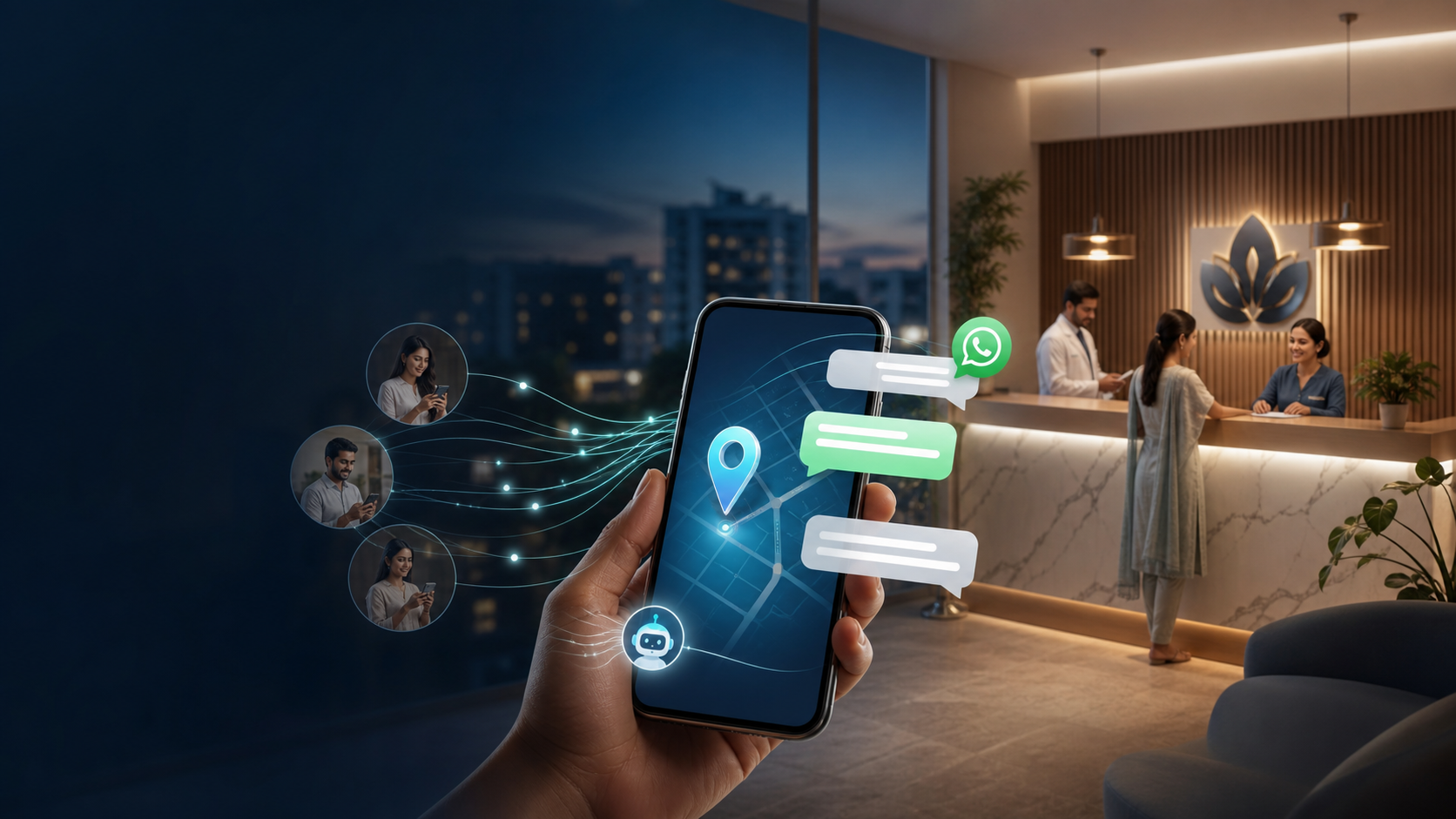
If you own a clinic in India, you are likely used to the rhythm of the front desk: the constant trill of the telephone, the frantic scribbling in appointment diaries, and the occasional missed call that someone will surely call back later. We value our front-office staff because they are the human face of our practice. They manage tempers, explain billing, and offer the empathy a machine cannot replicate.
For the service page behind this idea, see the clinic WhatsApp enquiry and booking system Webwise builds around reception handoff, approved replies and reminders.
However, a silent shift has occurred in how the journey to your front desk begins. Google Maps has transitioned from a simple digital directory into an active, AI-driven concierge. It is no longer just showing your location; it is synthesising your reviews, answering patient queries via Ask Maps, and summarising your reputation before a human ever speaks to you.
The reality is stark: while your receptionist is busy handling a patient in the chair, Google's AI is interacting with three potential new patients on their smartphones. If your digital infrastructure is not ready to catch those leads, they do not wait. They simply tap the next pin on the map.
Estimated monthly leak, based on the clinics we have audited.
The reply window before a high-intent lead starts looking elsewhere.
The availability patients now expect from digital front doors.
The INR 30,000/month revenue leak
Every missed call is quietly costing you. In the high-velocity local markets of Mumbai, Delhi, or Bangalore, a potential patient searching for a dentist near me or a skin clinic open now is a high-intent lead. They have a problem, and they want it solved immediately.
Across the clinics we have audited at Webwise Digital, the average mid-sized practice loses upwards of INR 30,000 every month to leaky lead management. This is not just about missed calls during lunch breaks. It is the cumulative effect of:
- Delayed responses: A lead that is not acknowledged within a minute or two is usually gone. In the age of instant gratification, silence is interpreted as we are too busy for you.
- The after-hours void: Patients often research their health concerns late at night. If your clinic is closed on Google Maps and offers no immediate way to engage, you are invisible to the midnight searcher.
- Manual follow-ups: Relying on a human to manually call back 20 missed enquiries from the morning is inefficient. Half will have already booked elsewhere by the time your staff picks up the phone.
Consider the implications. An INR 30,000 monthly leak is INR 3.6 lakhs per year. That is the cost of a high-end diagnostic machine or a significant clinic renovation, lost simply because your digital door was locked when a patient knocked.
How Google Maps became an AI gatekeeper
Google's latest updates have fundamentally altered the Local Pack, the top three results on a map search. Through Gemini-powered features, Google is now doing the heavy lifting for the patient.
The death of the generic search
Search is moving from keywords to conversations. Instead of orthopaedic doctor, patients are asking, which orthopaedic doctor near me has the shortest wait times and handles sports injuries? Google's AI scrapes your reviews, your website content, and your profile attributes to provide a curated answer. If your data is thin, the AI's answer will be equally thin.
Ask Maps is the new FAQ
The new Ask Maps feature allows users to ask open-ended questions directly on your listing. Do they have wheelchair access? Is there a female dermatologist available on Saturdays? The AI answers these by pulling from your existing digital footprint. If you have not structured your information correctly, the AI might guess, or worse, remain silent.
AI review summaries
Google now provides AI-generated summaries of your patient feedback. It does not just show a 4.5-star rating; it creates a paragraph: patients appreciate the clean facilities and the doctor's expertise, though some mention challenges with the parking area. This summary is often the first, and only, thing a patient reads before deciding to click.
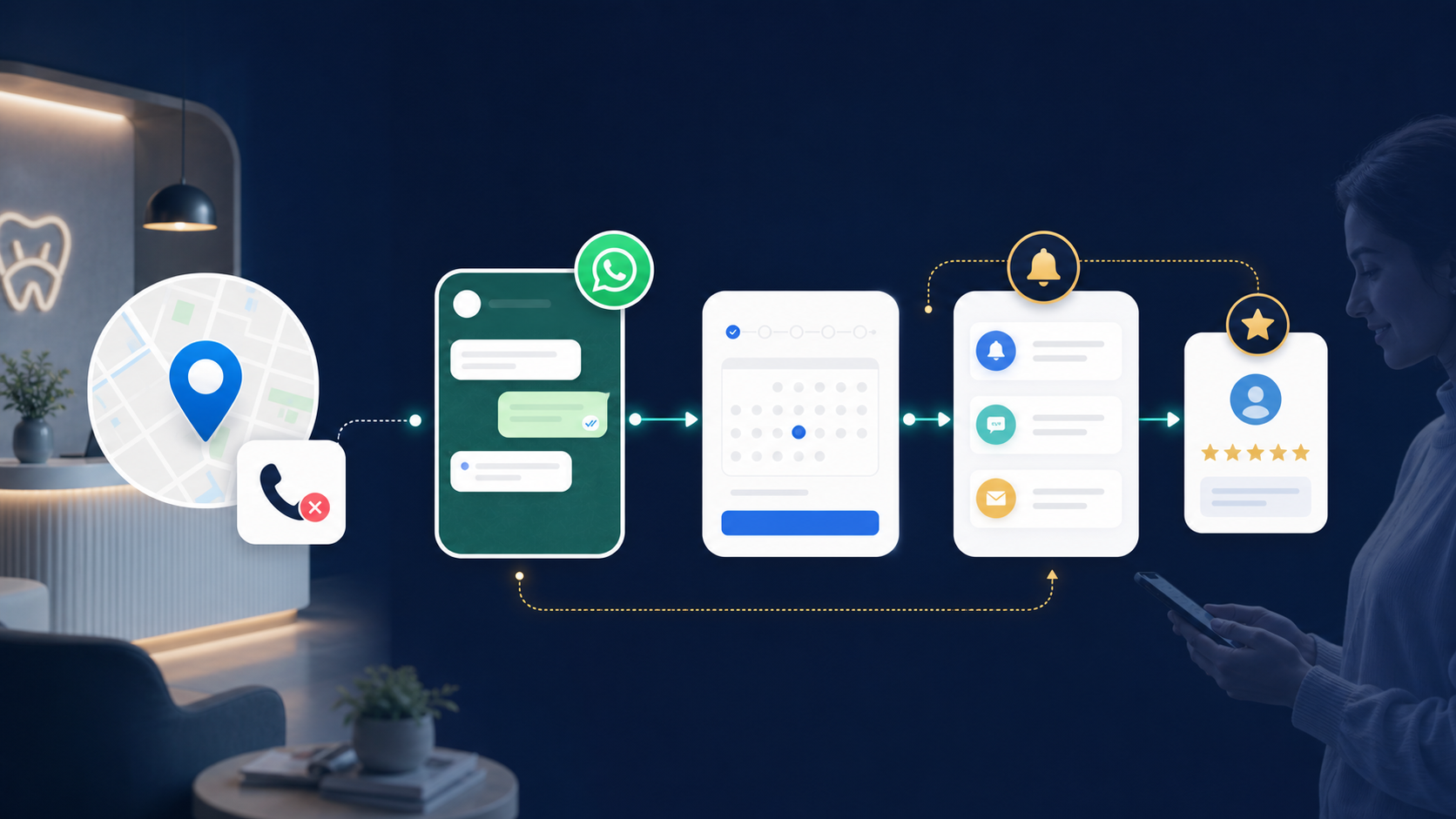
The conversion path: map discovery, WhatsApp reply, booking, reminders, and review capture.
Turning discovery into consultation
The shift in Google Maps creates a massive opportunity for clinics that pivot quickly. If Google is the engine of discovery, WhatsApp is the engine of conversion in India.
The goal is not to replace your receptionist but to augment them with WhatsApp automation for clinics in India. By bridging the gap between a Google Maps search and a WhatsApp conversation, you create a frictionless path to booking.
Indian consumers respond to WhatsApp far more readily than to email or a cold call, often many times more, in our experience running these flows. By implementing a system like LeadFlow, you ensure that every interaction initiated on Google Maps is immediately caught and nurtured.
How the LeadFlow system stops the leak
LeadFlow is one connected system that runs your clinic's front door: capture, booking, reminders, reviews, and routine replies. Here is how each part works.
- Instant qualification: The AI assistant asks the patient about their concern, preferred timing, and location.
- Zero latency: The response happens in seconds, not hours. The patient feels heard and stops searching for other clinics.
- Data capture: Even if they do not book immediately, you now have their contact details in a structured database for future re-engagement.
Beyond the Book Now button
Many clinic owners believe that having a Book Now button is enough. It is not. Healthcare is a high-trust industry. A patient rarely wants to pick a slot on a cold calendar; they want to feel that their specific problem is understood.
This is where LeadFlow's in-chat booking changes the dynamic. Instead of a generic web form, the booking happens inside WhatsApp, the app your patients already use every day.
- Selection: The patient chooses their service and doctor within the chat.
- Confirmation: They receive an instant calendar invite and a location pin.
- Reminders: Automated sequences sent 24 hours and two hours before reduce no-shows, a major pain point for Indian clinics.
- Rescheduling: If the patient cannot make it, they can reschedule with a single tap, rather than calling and potentially being put on hold.
By automating the administrative drudgery, your receptionist is freed up to do what they do best: provide a high-quality in-person experience for the patients already in the clinic.
Winning the reputation game
As mentioned earlier, Google's AI now summarises your reviews. This means your reputation is more important than ever for lead generation for clinics and salons. A handful of negative reviews that go unanswered can poison your AI summary, making you look unreliable to the algorithm.
The catch is that happy patients rarely remember to leave a review, while unhappy ones never forget.
LeadFlow's review engine automates the reputation cycle. After a patient leaves your clinic, they receive a gentle WhatsApp message asking for feedback.
- Positive feedback: If they are happy, they are directed to Google Maps to leave a 5-star review.
- Negative feedback: If they have a complaint, the system captures it privately and alerts you immediately. This allows you to resolve the issue before it ever becomes a public black mark on your profile.
This proactive approach ensures your AI-generated summary on Google Maps remains overwhelmingly positive, driving more organic traffic without a single rupee spent on ads.
A 3-step strategy for 2026
Step 1: Audit your digital front door
Search for your clinic on Google Maps. What does the AI see? Are your services listed individually? Are your hours accurate? Does your description answer common questions? Use the Ask Maps lens to view your profile. If the information is missing, the AI will bypass you.
Step 2: Implement lead capture, not just lead gen
Generating leads is easy; capturing them is hard. Ensure that every point of contact, your Google listing, your website, and your Instagram, leads to a single, automated WhatsApp channel. This centralises your communication and ensures no patient falls through the cracks.
Step 3: Automate the routine, humanise the rare
Identify the tasks your staff does repetitively: booking, reminders, and answering what are your timings? These should be handled automatically by LeadFlow's auto-reply, so your human staff are saved for complex patient cases, emotional support, and high-value consultations.
The bottom line
The integration of AI into Google Maps is not a threat; it is a filter. It filters out the clinics that are difficult to reach, slow to respond, and digitally stagnant. It rewards the clinics that are accessible, transparent, and immediate.
By embracing WhatsApp automation for clinics in India, you are not just buying a tool. You are installing a 24/7 digital receptionist that never sleeps, never misses a call, and never forgets to follow up.
The INR 30,000 you are losing every month is not gone yet. It is just waiting for you to fix the leak.
FAQs for clinic owners
Why does Google Maps matter so much for clinics now?
Google Maps is often the first place a high-intent patient compares clinics, reads reviews, checks hours, and decides who to contact. AI summaries and Ask Maps make complete, fresh clinic data even more important.
What is the fastest way to stop missed clinic enquiries?
Route Google Maps, website, and social enquiries into one WhatsApp-led capture flow, then automate first replies, reminders, and follow-ups so patients are acknowledged within seconds.
Does automation replace the clinic receptionist?
No. It handles routine capture, reminders, and follow-up so the receptionist can focus on patients in the clinic and higher-trust conversations.